Read the story in The New York Times HERE

Above Image: Larry Towell/Magnum Photos
A 1993 image of an Arab child and an Israeli soldier after a protest in East Jerusalem is part of Magnum's archives in Austin.
A 1993 image of an Arab child and an Israeli soldier after a protest in East Jerusalem is part of Magnum's archives in Austin.

A new entry in the Criterion Collection’s no-frills Eclipse series, “Chantal Akerman in the Seventies” offers five films by this Belgian director best known for her 1975 “Jeanne Dielman, 23 Quai du Commerce, 1080 Bruxelles,” a seminal work of women’s cinema that combined gender politics with an innovative style using long takes to underline the passing of time.
The set includes Ms. Akerman’s first feature-length film, the 1975 “Je Tu Il Elle,” in which she plays an alienated young woman on a road trip punctuated by two erotic encounters; and “Les Rendez-Vous d’Anna,” a more mainstream feature from 1978, centered on a film director (Aurore Clément) and her glancing contacts with humanity during a promotional tour of European cities.
Both are challenging and often beautiful works, but the highlight of the set may be the disc called “The New York Films.” It unites two of the short, experimental works that Ms. Akerman made in Manhattan during a 1971-73 residency, and the 86-minute “News From Home” (1976), a return to New York filmed after “Jeanne Dielman.”
All three were made in collaboration with the cinematographer Babette Mangolte. And all three reflect Ms. Akerman’s fascination with the avant-garde work — by filmmakers like Marcel Hanoun, Yvonne Rainer and Michael Snow — that she discovered at Anthology Film Archives during her New York stay. Taken together they allow us to see a young artist absorbing her influences and confidently moving into territory of her own.
The 11-minute single-shot film “La Chambre” borrows a formal device from Michael Snow’s “Région Central” (1971), in which a coldly precise camera movement is used to survey a space, here a cramped one-room apartment. As the camera pans in a full circle (three rotations from right to left, then suddenly from left to right), it passes Ms. Akerman lying in bed in poses that variously suggest sloth, sensuality and paralysis. A geographical gesture in Mr. Snow’s work here becomes something domestic and dramatic, allowing us to infer a story from these few glimpses of a woman confined in her personal space, as “Jeanne Dielman” would do more extensively and expressively.
In “Hotel Monterey” (1972) Ms. Akerman expands her vision to include an entire building. A residential hotel on the Upper West Side is covered from bottom (the lobby and lounge area) to top (the camera strains to peer out windows on the upper stories, trying to catch a glimpse of the Hudson). Filmed over the course of a single night, the movie proceeds from dark elevators and dimly lit corridors to expansiveness and sunshine, while the human presence gradually drains away. These images have a lyrical loneliness that critics have compared to the works of Edward Hopper, but there is something more spectral here too, a haunting emptiness that looks forward to similarly filmed hallways in Stanley Kubrick’s “Shining” (1980).
The spatial configuration of hallways returns on a grander scale in “News From Home” as eerily unpopulated New York streets. This time there are no domestic interiors, but only public places: an East Village corner covered by a slow pan, a view from the side window of a car driving up a far West Side avenue, extended shots of subway interiors (in which some passengers can be seen defiantly returning the camera’s gaze).
The two previous films were silent, but “News From Home” has a crowded soundtrack consisting of city sounds blended with Ms. Akerman’s own voice, reading increasingly imploring letters from her mother back home in Belgium. As in “Jeanne Dielman” we gradually become able to infer a story — this time, of a young woman’s growing autonomy and escape from the past.
Like William Friedkin’s “French Connection,” “News From Home” has, with time, become a documentary on New York in the 1970s. Lingering shots of pre-gentrified downtown neighborhoods, graffiti-slathered subway cars and the little village of shops and stands that once filled the Times Square station now carry a sense of impermanence and inaccessibility, of a world receding into the past, just as notions of “home” have receded for the unseen protagonist.
The final image — a 10-minute take from the deck of the Staten Island ferry, looking back on a lower Manhattan fading into fog and mist — now carries an extra charge. Defining the left border of the frame is the World Trade Center. (Criterion Collection/Eclipse, $44.95, not rated)
Above content from The New York Times

Curated by Berta Sichel for cifo
December 2, 2009 - March 7, 2010
The Cisneros Fontanals Art Foundation (CIFO) is proud to present Being in the World: Selections from the Ella Fontanals-Cisneros Collection, an exhibition curated by Berta Sichel on view from December 2, 2009 to March 07, 2010, coinciding with Art Basel Miami Beach (Dec. 2-6 2009).
Being in the World: Selections from the Ella Fontanals-Cisneros Collection is freely framed by the idea of situation as it was developed by French philosopher Jean-Paul Sartre. Sartre's situation, or being in the world, includes an individual's place-or current circumstance-and that person's memory, which is a closed circuit providing a background view. The way an individual understands his/her position in the world is a product of past and present circumstances, which include people, close friends and acquaintances as well as strangers who pass unnoticed.
The exhibition proposes this as a useful model for understanding recent artworks which struggle with the individual in a changing world. Being in the World includes 7 artists whose works were selected from the 63 media-based works in the collection. It features works by leading artists Chantal Akerman, Rafael Lozano-Hemmer, Muntean/Rosenblum, Robin Rhode, Shirin Neshat, Bill Viola, and Francesca Woodman.
The works in Being in the World: Selection from the Ella Fontanals-Cisneros Collection, might also be closest to Sartre's notion of the difference between life and art, since for Sartre art only belongs to us if it restores ambiguity and sometimes a brutal freshness to actual events. In one way or another, the works selected all tell stories, and for Sartre to tell a story when we don't know the outcome creates illusion. Some of these stories are close to reality, others drawn from imagination, but all have uncertain outcomes. All describe situations, ways of being in world. Together they transmit the freedom of art, the freedom of choice-the only freedom Sartre recognized. That is their intrinsic value.
Featuring work by: Chantal Akerman, Rafael Lozano-Hemmer, Muntean/Rosenblum, Shirin Neshat, Robin Rhode, Bill Viola and Francesca Woodman I had to borrow this link from my colleague Peter Happel-Christian as I found it so wonderfully hilarious. And, as Peter suggests in his post on his Creative and Social Blog at St.Cloud State University in Minnesota, sometimes the images in the "wrong" column are much, much more interesting than those in the "right" column. Have a look - it's a good time, I swear (just click on the link below)...
 (Click on the image to access the link to Photo-Eye)


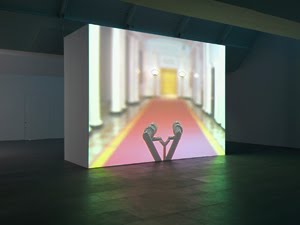
Omer Fast: Nostalgia
Through February 14, 2010

 For over 30 years, photo-eye has published our annual selections for Best Books of the year. Last year we started what we hope will be a long tradition of inviting photographers, writers, curators, publishers, and other photo professionals to select their 10 top books of the past year. Among the list are a few of the wonderful guest contributors from last year and some new additions.
 Since 1980, Chuck Samuels has been using the history of photography and cinema to explore philosophical questions concerning memory and the construction of the self in a body of work shaded with irony. His work, which has been seen widely in Canada and abroad, can be found in collections such as that of the Maison européenne de la photographie in Paris, the Musée de la Photographie de Charleroi.
This task, which is much more than a stylistic exercise, derives from Samuels’ enquiry into the nature of the bond that tied him to his father. In Chuck Goes to the Movies, 108 photographs form the basis of an exuberant analysis of photographic representation in popular cinema and television from their early days until 1967, the year Samuels was introduced to photography by his father. Here Samuels, a kind of Zelig of the camera lens, offers up a delirious repertoire of possibilities, hypotheses and characters. Chuck’s Home Movies takes a similar tack, creating free associations between clips from a number of films with iconic depictions of photographers.
In the other two sections of the exhibition, Last Words on Photography and Chuck’s Family Photos, Samuels speaks directly of his memories of his father to paint an emblematic, perhaps even mythical, portrait of the “man with a camera”, thereby highlighting and interrogating an entire field of recent cultural history which has suddenly become accessible and even popular, one marked by the desire of individuals to see themselves depicted in it.
Above content from Daziboa Centre de Photographies Actuelles

 On the occasion of the First Annual Art Awards, the Guggenheim is proud to honor Joan Jonas and Kasper Koenig with Lifetime Achievement Awards for their extraordinary contributions to the field of contem- porary art.